Our commitment to sustainability

Across our diversified lines of business, Hydro Ottawa Group is playing a leadership role in helping customers and communities lower their energy footprint. Grounded in our 2026-2030 Strategic Direction, sustainability is no longer just a foundation for our decisions. It defines our mission and shapes our identity.

As a strategic partner to the communities we serve, we are actively delivering on regional economic development and environmental targets. Our approach for the 2026-2030 period is two-pronged: we are shooting for the moon to become the first municipally-owned utility in Canada to achieve net-zero operations by our aspirational target of 2030, while simultaneously accelerating our service offerings to support local partners in their own decarbonization efforts.

We believe actions to reduce our own emissions go hand-in-hand with the solutions we implement for others. By driving innovative energy solutions, Hydro Ottawa Group ensures that a smart energy future remains intrinsically linked to a sustainable one.


Why leading the way to a smart energy future is critical

A historic transformation is underway when it comes to how energy is produced and consumed.

To address climate change and the growing need for electrification, Hydro Ottawa Group is actively implementing smart energy solutions. These advancements are crucial for supporting a more reliable, efficient, and sustainable energy landscape. Our commitment involves developing cutting-edge technologies and forging strategic partnerships to construct a brighter energy future.

Given that energy use and the environment are fundamentally connected, we are committed to leading the way to a smart energy future. This means advancing connectivity, promoting energy conservation and efficiency, and actively pursuing renewable energy generation partnerships.

Defining a smart energy future

A ‘smart energy future’ refers to an energy system that adapts to evolving needs and uses technology to maximize benefits for consumers, the community and the environment. Hydro Ottawa Group envisions this future as sustainable, customer-centric, reliable, and secure.

Key components

Modernized infrastructure: This effort is dedicated to upgrading and optimizing the physical components of the electricity network by incorporating technologies that enhance efficiency, reliability, and overall grid performance, including the deployment of smart grids, advanced metering infrastructure (AMI), and sophisticated digital platforms for grid management.

Increased renewable energy production: This goal centres on expanding the capacity for generating energy from renewable sources, including solar, wind, hydro, and biomass, and integrating these diverse energy sources effectively into the overall energy grid to create a cleaner and more sustainable energy mix.

Sustainability and decarbonization: These priorities drive the commitment to reduce greenhouse gas emissions and minimize the environmental impact associated with energy production and consumption, achieved through the promotion of energy efficiency practices, the electrification of various sectors, and the widespread adoption of renewable energy sources.

Microgrids: These systems operate connected to the main electricity grid but can disconnect during disruptions (like storms and power outages) to function independently using local energy generation – such as solar panels or batteries.

Smart communities: These interconnected communities use smart technologies to power homes, buildings, and transportation, to benefit residents, businesses and service organizations.

District energy resources: These systems produce and supply thermal energy. Central plants produce hot and chilled water, which is distributed to surrounding buildings through underground thermal grids, efficiently heating and cooling buildings without individual furnaces, boilers or chillers.

Community empowerment: These combined objectives prioritize providing customers with increased control over their energy consumption while fostering a collaborative relationship to achieve shared community energy goals. This is accomplished by ensuring access to the necessary tools and information to make informed energy decisions, often through user-friendly energy management platforms and personalized energy solutions.

Innovative energy solutions: These solutions involve the ongoing development and implementation of smarter energy technologies and services, designed to optimize energy use and delivery while fostering new approaches to meet evolving energy demands.

Our journey to net-zero operations

In 2021, we set an aspirational target for Hydro Ottawa Group to achieve net-zero operations by 2030. We are proud of the progress so far and have firmly embedded sustainability into our operations now and into the future.

Measuring our progress relies on diligently tracking Scope 1 and Scope 2 greenhouse gas (GHG) emissions, which together allow us to assess our environmental impact.

  • Scope 1 emissions directly result from our owned or controlled sources, such as emissions from fleet vehicles, natural gas consumption in our facilities, and sulfur hexafluoride (SF6) used in electrical equipment.
  • Scope 2 emissions are indirect emissions from the generation of purchased electricity we consume, as well as line losses that occur during distribution.

Below is an update on Hydro Ottawa Limited’s progress through 2025:

Metric 2022 2023 2024 2025
Scope 1 GHG emissions (metric tonnes of CO2) 2,505 1,914 2,429 2,518
Scope 2 GHG emissions (metric tonnes of CO2) 5,692 5,846 7,314 9,395

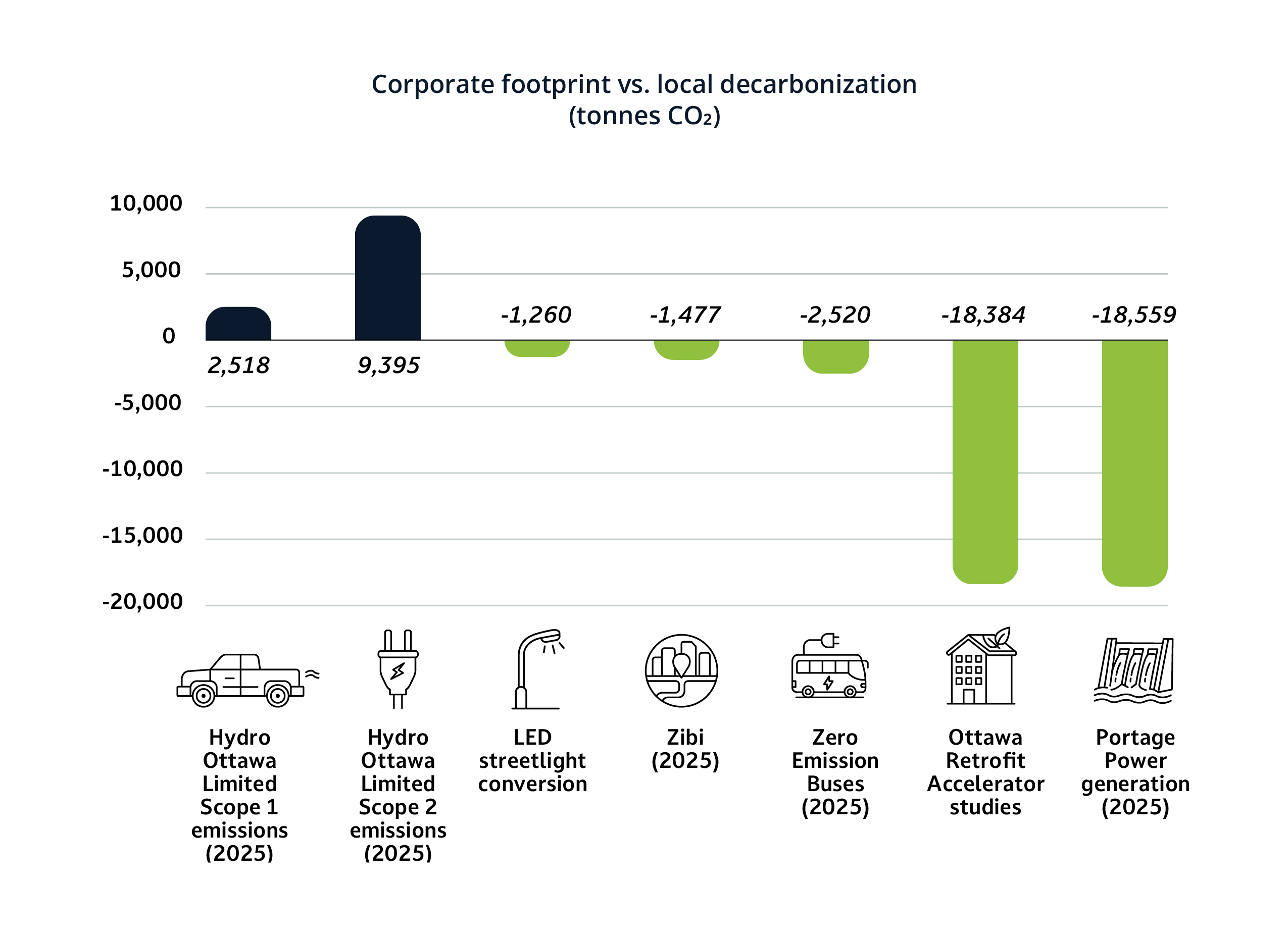
As we continue to focus on reducing our emissions, we’ve set another goal for the 2026-2030 period – to fortify our status as the partner of first choice for clean energy and carbon reduction projects in our community. It is through these projects that we can best move the climate needle, as the carbon reductions we enable for others greatly exceed any cuts we can make to our own limited footprint. The chart below shows the impact we made in 2025 alone:

Legend

LED streetlight conversion: estimated annual emission reductions associated with converting ~60,000 streetlights across Ottawa

Zibi: estimated annual emission reductions relative to business-as-usual

Zero Emission Buses: estimated annual emission reductions associated with 36 electric buses being in-service (based on OC Transpo’s projected reductions per bus)

Ottawa Retrofit Accelerator: potential annual emission reductions associated with carbon-reduction measures identified for local building owners through 2025 studies (i.e. no certainty of actual implementation)

Portage Power generation: GHG-reduction value of production from all Ontario and Quebec-based stations in 2025 (total generation multiplied by the Federal Government’s emissions factor for Ontario’s grid)

Leading through innovation

As part of Hydro Ottawa’s strategic focus on corporate citizenship, we embrace sustainability and innovation. Learn more about the projects we’re investing in on our journey to a smart energy future.